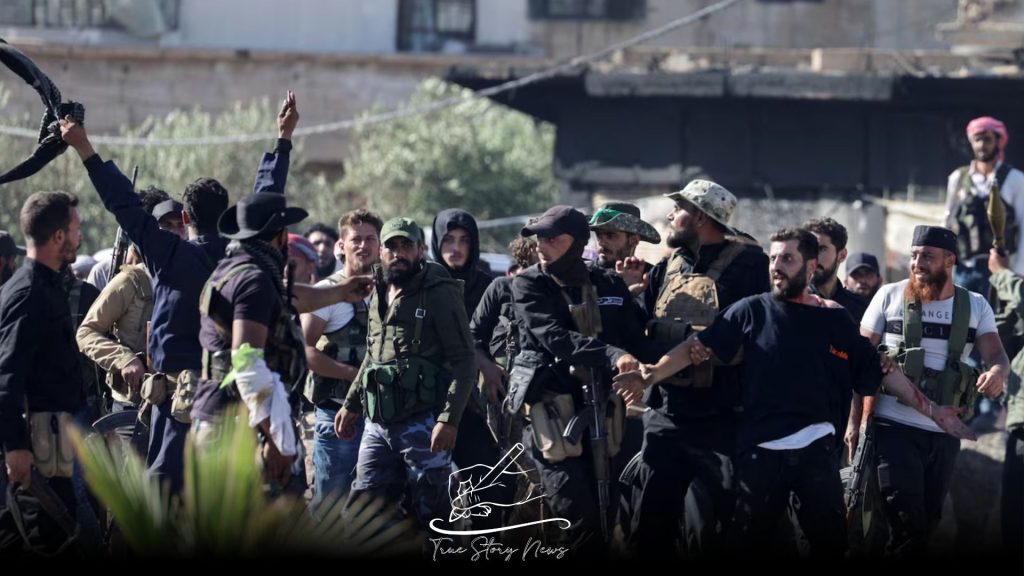
Sectarian clashes intensified in Syria’s predominantly Druze region of Sweida on Saturday, marked by the sound of machinegun fire and mortar shelling following days of violence, as the Islamist-led government faced challenges in enforcing a ceasefire.
Gunfire was reported by Reuters reporters from within the city of Sweida, accompanied by observations of shells landing in adjacent villages. No immediate or confirmed reports of casualties have emerged.
The government announced that security forces are being deployed in the southern region to maintain peace, urging all parties to cease hostilities following nearly a week of factional violence that has resulted in hundreds of fatalities.
On Saturday evening, the interior ministry announced that hostilities in Sweida city had ceased, with the area now cleared of Bedouin tribal fighters following the recent deployment.
A British-based monitoring group, the Syrian Observatory for Human Rights, reported that clashes in the Sweida region since last week have resulted in a death toll of at least 940 individuals. Reuters could not independently verify the toll.
Interim President Ahmed al-Sharaa stated that mediation efforts from both Arab and American parties played a crucial role in restoring calm before the escalation of clashes. He expressed criticism towards Israel regarding the airstrikes that occurred during the week.
Violence in the Druze region poses significant challenges for Damascus.
The recent clashes represent a significant challenge to the authority of Sharaa’s Islamist-led government, which assumed power following the ousting of autocratic president Bashar al-Assad in December.
Last week marked the beginning of violent confrontations involving the Druze, a religious minority indigenous to southern Syria, the Israeli-occupied Golan Heights, and regions of Lebanon and Jordan, alongside Syrian Bedouin tribes.
Government forces subsequently intervened in an attempt to ease rising tensions, engaging in confrontations with Druze gunmen and launching assaults on the Druze community.
Witnesses reported that Saturday’s violence reignited tensions between the Druze and Bedouin communities.
This week, the ongoing conflict has escalated, prompting Israel to conduct airstrikes in southern Syria, targeting the defence ministry in Damascus, as government forces engaged in combat with the Druze community. Israel asserts that it is safeguarding the Druze community, which constitutes a notable minority within the country.
However, there are notable differences between Israel and the United States regarding Syria. The United States backs a unified Syria under the leadership of Sharaa, who has committed to governing for the benefit of all citizens. In contrast, Israel contends that the government is heavily influenced by jihadists, posing a threat to minority groups.
In March, reports emerged of Syria’s military engaging in mass killings targeting members of the Alawite minority, a group closely associated with the elite surrounding President Assad.
Rising tensions between Israel and Syria have captured international attention, as both nations navigate a complex landscape of geopolitical challenges and historical conflicts. The situation remains fluid, with potential implications for regional stability and security.
On Saturday, the Syrian presidency issued a statement declaring an immediate ceasefire and calling for an end to hostilities without delay. Sharaa emphasised that Syria will not serve as a “testing ground for partition, secession, or sectarian incitement”.
In a televised address, he stated, “The Israeli intervention has propelled the country into a perilous phase that jeopardises its stability.”
Sharaa has pointed fingers at Druze gunmen for the recent clashes, alleging that they are conducting revenge attacks against Bedouins.
Israeli Foreign Minister Gideon Saar accused Sharaa of aligning with the perpetrators.
“In al-Shara’s Syria, being a member of a minority—whether Kurd, Druze, Alawite, or Christian—poses significant dangers,” he stated on X.
On Friday, US envoy Tom Barrack confirmed that Syria and Israel have reached an agreement for a ceasefire.
Barrack, serving as the US ambassador to Turkey and Washington’s envoy for Syria, called on Druze, Bedouins, and Sunnis, along with other minority groups, to “forge a new and unified Syrian identity”.
In the seven months following the fall of Assad, Israel has launched attacks on Syrian military facilities, asserting its desire for the southern regions of Syria adjacent to its border to remain free of military presence.
On Friday, an official from Israel announced that the country had consented to grant Syrian forces restricted access to Sweida for two days.
Sweida Hospital Experiences Influx of Casualties
Mansour Namour, a resident from a village close to Sweida city, reported that mortar shells continued to strike near his residence on Saturday afternoon, resulting in at least 22 injuries.
A physician in Sweida reported that a local hospital is overwhelmed with casualties and injured individuals following several days of violence.
Numerous injuries have been reported, primarily attributed to bomb blasts, with several individuals suffering from chest wounds. “There are also injuries to limbs from shrapnel,” stated Omar Obeid, the hospital director.