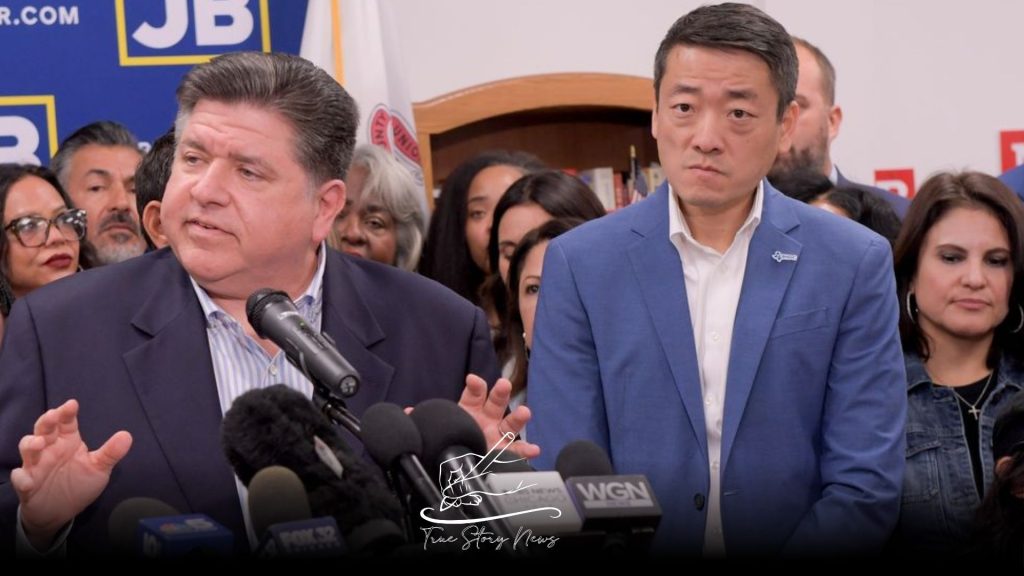
In a bold move, Democratic state lawmakers have left Texas to obstruct a vote on a proposed congressional map that is poised to benefit Republicans significantly.
Last week, Texas’s majority Republicans revealed a proposed redistricting plan, which has garnered support from President Donald Trump. This plan aims to establish five new Republican-leaning seats in the US House of Representatives. The Republican Party holds a narrow majority in the House of Representatives at this time.
A quorum of two-thirds of the 150-member state legislature is required to conduct a vote. In a significant political manoeuvre, fifty-one Democratic lawmakers have departed from Texas, with the majority relocating to Illinois, effectively preventing Republicans from achieving the necessary quorum.
Officials announced their intention to remain absent for two weeks, coinciding with the conclusion of a special legislative session.
Texas Governor Greg Abbott, a member of the Republican Party, convened the session. He has issued a warning to attempt to oust any lawmakers who do not return to Texas for a vote.
The Texas legislature convenes to address critical issues, including disaster relief in response to last month’s devastating floods, the prohibition of THC, the active component in cannabis, and the approval of proposed electoral redistricting plans.
The 51 lawmakers who are currently absent from their duties may incur a fine of $500 (£380) for each day of their absence. Texas Attorney General Ken Paxton, representing the Republican Party, has issued a warning that he may pursue their arrest.
Paxton expressed on X that the state must “utilize every tool at our disposal to pursue those who believe they are above the law”.
“Democrats in the Texas House who attempt to evade their responsibilities should be located, apprehended, and returned to the Capitol without delay,” he stated.
Texas Democrats stated in defense of the move.
“We are committed to fulfilling our responsibilities,” stated state legislator and chairman of the Democratic caucus Gene Wu.
“We are exiting a system that is fundamentally flawed and consistently disregards the voices of those we serve.”
State Democrats garnered support from prominent figures within the national party. House Minority Leader Hakeem Jeffries praised the group for demonstrating “courage, conviction and character.”
As Democrats across the country consider retaliatory strategies, they may find their choices constrained.
In states like Illinois, New Mexico, and Nevada, where the redistricting process is managed, Democrats have engaged in gerrymandering with the same enthusiasm as their Republican counterparts.
The latest Illinois map has garnered an F grade from the Princeton Gerrymandering Project, highlighting its significant political unfairness.
In contrast, several Democratic-controlled states, including New York, California, Colorado, and Washington, employ non-partisan, independent commissions to manage redistricting, as opposed to relying on state legislatures.
In the Lone Star State, Texas Republicans occupy 25 of the 38 congressional seats.
The expectation is that the new maps boost that figure to 30, specifically in constituencies where Trump secured victories last November by a margin of at least 10 points.
As the nation gears up for the midterm elections next year, Texas’s redistricting efforts may bolster the narrow Republican majority in the House of Representatives, the lower chamber of Congress.
The Republican Party, led by Trump, currently occupies 219 of the 435 seats in the House of Representatives, in contrast to the Democrats, who hold 212 seats.
A proposed new map aims to redistrict the Rio Grande Valley while merging two districts in Austin, the state capital, that are presently represented by Democrats.
In northern Texas, the proposed map seeks to broaden a district currently represented by Democratic congresswoman Julie Johnson, incorporating areas traditionally dominated by Republican voters.
The proposal includes a redrawing of four congressional seats in the Houston area, notably affecting the district currently represented by Democratic Congressman Al Green.
Texas state legislator Todd Hunter, a Republican and proponent of the measure to redraw the map, described it as “a good plan for Texas.”
For the third time in recent years, Democrats have left Texas to prevent Republicans from achieving a quorum.
In 2021, the party’s legislators travelled to Washington, DC in a bid that ultimately fell short in their efforts to obstruct the implementation of new election rules.
In 2003, Texas Democrats fled to Oklahoma to thwart a redistricting plan that ultimately received approval from Republicans.
Every decade, states engage in the process of redistricting, during which voting maps are revised to reflect shifts in population demographics.
The latest US Census took place in 2020. It is uncommon to redraw district lines halfway through a decade.