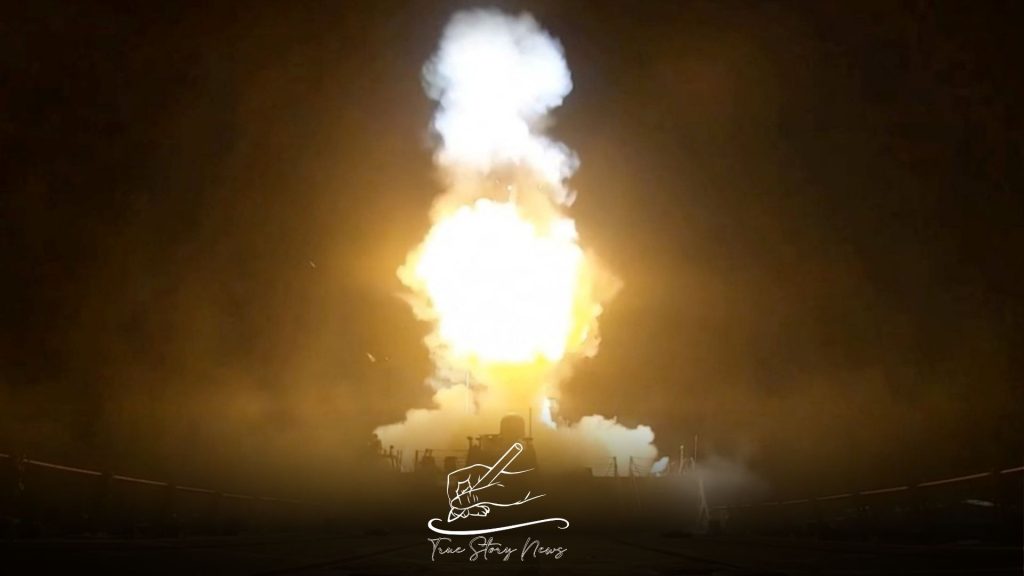
On Tuesday, US forces conducted attacks against Iran for the fourth consecutive day and reinstated a naval blockade to obstruct maritime traffic to and from the nation’s ports.
Although US President Donald Trump retracted his promise to impose substantial taxes on vessels traversing the Strait of Hormuz, he cautioned that he would escalate US military actions against Iran the following week to target power plants and bridges if Tehran fails to reach an agreement.
Next week will be particularly detrimental for them since the power plants will arrive. The bridges will be addressed next week,” Trump stated during an interview on Fox News. We will incapacitate all their power facilities. We will dismantle all their bridges until they engage in negotiations.
US Central Command (CENTCOM) said that the recent attacks aimed to weaken Iran’s ability to attack commercial shipping in the Strait of Hormuz, an important route for Gulf oil and gas, where Iran has repeatedly targeted civilian ships.
Iranian state media reported detonations in proximity to the port city of Bandar Abbas, on the Gulf island of Qeshm adjacent to the Strait of Hormuz, and in additional sites.
The Iranian news agency IRNA subsequently reported that Iranian forces executed a drone strike on a military installation in Jordan that accommodates American aircraft.
The reinstated US naval blockade commenced at 2000 GMT, one hour subsequent to the initiation of US strikes, with a high-ranking Iranian official asserting that this action essentially undermined an agreement made with Washington to suspend hostilities for peace negotiations.
Deputy Foreign Minister Kazem Gharibabadi stated that the US decision to extend the ban “has, in effect, nullified the Islamabad memorandum.”
Admiral Brad Cooper, commander of CENTCOM, stated on Tuesday that in the preceding week, “Iran has deliberately targeted people around the region by assaulting seven commercial vessels, resulting in over a dozen civilian crew members being killed, missing, or injured. US forces are holding Iran responsible for unjustified aggression that persists in jeopardizing innocent lives,” he stated.
On Tuesday, Iran said that a prior series of US strikes targeted Qeshm, while local officials indicated that US forces attacked “four locations” in Bushehr, home to Iran’s sole civilian nuclear power plant, as well as an Iranian border region adjacent to Iraq and Kuwait.
Trump abolishes taxes
According to the International Maritime Organization, Iran subsequently attacked two vessels in the Strait of Hormuz, resulting in the deaths of two crew members.
Early Tuesday, a Norwegian ship was struck by an explosion from an unexplained item off the coast of Oman, according to the crisis response firm MTI Network.
Kuwait reported that one of its navy vessels was hit during an Iranian missile and drone assault, resulting in injuries to four crew members. Kuwait reported that an Iranian missile and drone assault hit one of its navy vessels, injuring four crew members. The assault resulted in injuries to four crew members.
Trump announced the cancellation of a proposed levy on vessels transiting the Strait of Hormuz, which he had declared on Monday, substituting the cost with trade agreements with Gulf partners. Trump stated in a post on his Truth Social network, “I have resolved to substitute the 20% United States reimbursement fee with trade and investment agreements that the different Gulf states would establish with the United States.
Since the previous week, fresh US strikes have resulted in the deaths of at least 28 individuals in Iran, as reported by an AFP count derived from Iranian media and official statements.
On Tuesday, Iran’s Revolutionary Guards declared that they had launched missiles and drones toward Bahrain, aiming for a residential structure for US personnel and additional installations. Declaration of hostilities Bahrain reported intercepting “multiple nefarious aerial assaults initiated by Iran” and accused Tehran of aiming at civilians, following the occurrence of explosions and sirens in Manama on several occasions.
Tehran also initiated assaults on additional US allies in the region, including Jordan, which reported on Tuesday that it had intercepted four missiles originating from Iran.
Israeli Prime Minister Benjamin Netanyahu, a staunch adversary of Iran’s purported nuclear aspirations, cautioned Iranian leaders on Tuesday that Israel would inflict significant damage if they initiated an assault on his nation.
From Dimona, a southern village widely believed to be the site of Israel’s secret nuclear arsenal, Israeli Prime Minister Benjamin Netanyahu addressed the audience, stating, “Do not anticipate tranquility if you launch an attack against us. We are ending the period in which we accept an assault without providing a clear response. We will no longer accept an assault without retaliating with a definitive response.