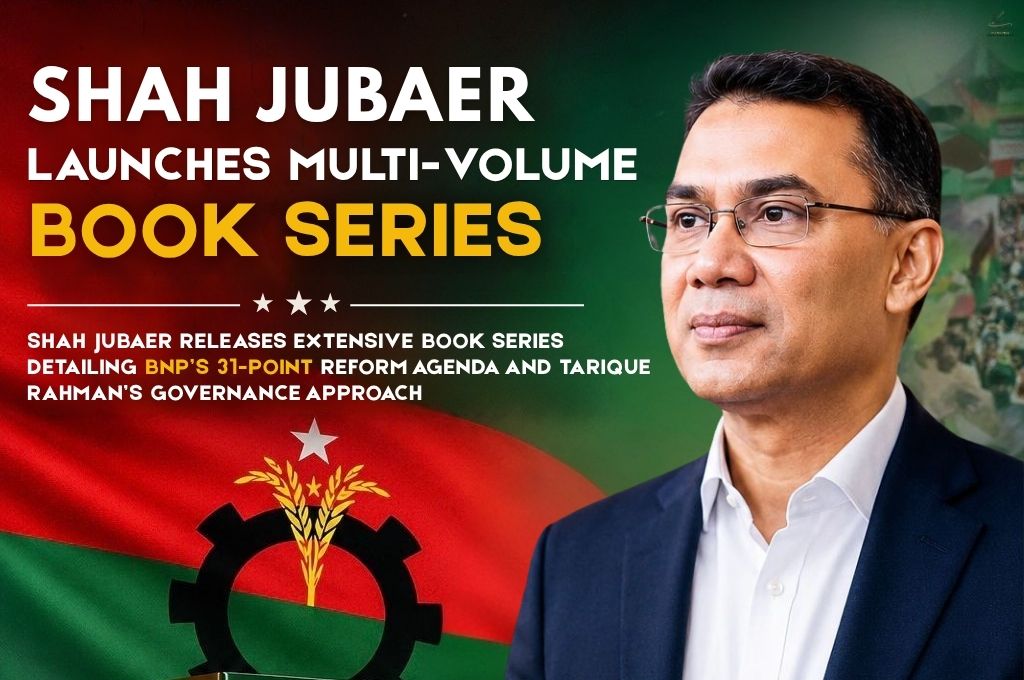
Dr Shah Jubaer, a legal scholar and policy analyst, has released a new multi-volume publication examining the Bangladesh Nationalist Party’s (BNP) 31-point reform agenda and the governance philosophy linked to party Chairman Tarique Rahman.
The series, titled Future Bangladesh: 31-Point Agenda for Change was published by the Intellectism Research Unit. The project offers an academic examination of the proposed reforms and explores how the BNP’s political commitments could be developed into practical legislative, administrative, and structural policies for Bangladesh.
From Political Commitments to Policy Proposals
Across the series, Jubaer examines the BNP’s 31-point programme through a range of policy and institutional perspectives, outlining possible approaches to implementing its major objectives.
Volume I (Resource & Infrastructure Overhaul): The first volume addresses infrastructure and resource management while focusing on issues that directly affect citizens. It examines proposals involving farmer support, smart multimodal transportation, climate-resilient waterway management, technology-led energy security, and sustainable housing solutions for growing urban populations.
Volume II (Institutional Clean-Up): The second volume turns to institutional reform and explores measures aimed at improving transparency, protecting civil rights, strengthening social justice, and modernising the country’s administrative and governance structures.
A Closer Look at Tarique Rahman’s Leadership
In addition to the book series, Jubaer has produced a detailed political study titled The Strength of BNP’s Unity under Tarique Rahman’s Leadership and the Seeds of the July Revolution.
The study examines the BNP’s organisational and policy development under Rahman’s leadership. Jubaer argues that the party has increasingly developed a structured and forward-looking policy platform, moving beyond traditional political resistance and placing greater emphasis on digital development, anti-corruption measures, institutional safeguards, and economic wellbeing.
Developing a Wider Governance Framework
Jubaer’s broader policy research also examines several concepts that he associates with the BNP’s 31-point programme and Tarique Rahman’s proposed governance model.
Tarique Rahman’s Agricultural Development Theory: In this study, Jubaer examines Rahman’s approach to agriculture and develops a policy framework focused on supporting smallholders, strengthening food sovereignty, improving rural productivity, and introducing smart farming technologies.
A Policy Study of Tarique Rahman’s Curriculum Vision for Bangladesh: Jubaer also analyses the proposed direction of Bangladesh’s education system, highlighting technology education, vocational preparation, and the development of skills that can help students compete within the global digital economy.
Bangladesh First Principle: Tarique Rahman’s Political Governance Philosophy: This foundational study examines what Jubaer presents as a sovereign and merit-based approach to governance, with an emphasis on national development, institutional independence, protection from external elite influence, and greater public accountability.
Jubaer places these policy studies within his wider academic framework, known as the Theory of Contextual Democracy. He argues that successful structural reform in Bangladesh must be designed around the country’s particular economic, social, and cultural conditions. According to his conclusion, ensuring that proposed reforms remain connected to local realities will be critical to their sustainability and long-term effectiveness.